
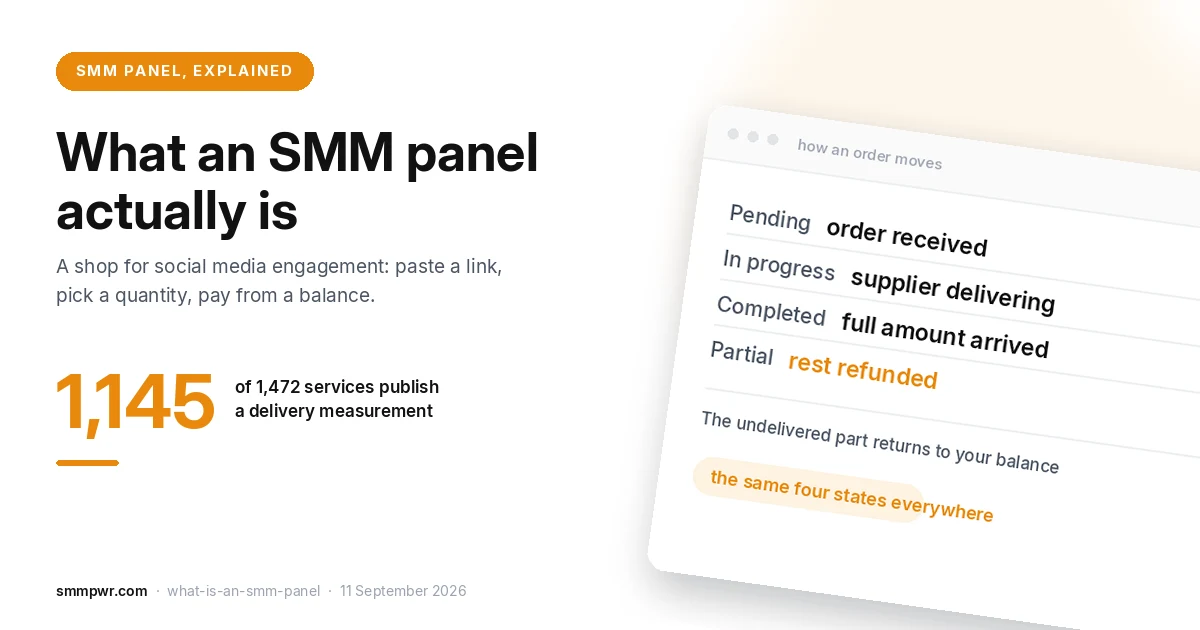
An SMM panel is a website where you buy social media engagement — followers, likes, views, comments — one order at a time, by pasting a link and choosing a quantity. You top up a balance, pick a service from a price list, and the panel passes your order to whoever actually delivers it. Most panels are resellers, not producers.
What does an SMM panel do?
It turns a supplier's delivery network into a self-service shop. Instead of negotiating with a provider, you get a catalogue with a fixed price per 1000, a minimum and a maximum order size, and an order form. The panel takes your money, places the order upstream, and reports progress back to you. That is the whole product: a storefront, a price list and an order pipeline.
How does an SMM panel work?
Four steps, and they are the same everywhere. You create an account and add funds. You pick a service and paste the link to the post or profile. The panel charges your balance and sends the order to its supplier. The supplier delivers, and the panel shows the order moving from Pending to In progress to Completed. If part of the order never arrives, the status reads Partial and the unfilled amount is refunded.
Is an SMM panel legal?
Buying the service is not a crime anywhere we operate, but it does breach the terms of service of the platforms themselves — Instagram, TikTok, YouTube and the rest all prohibit artificial engagement. The consequence is platform level, not legal: removed counts, limited reach, in rare cases a restricted account. Anyone who tells you it is fully approved by the platforms is selling you something.
Is an SMM panel safe to use?
The panel never needs your password, and no honest one will ask for it. You submit a public link, not credentials, so the account access risk is zero. The real risks are different: paying for delivery that never arrives, engagement that disappears a week later, and support that stops replying. Those are the things worth checking before you spend money, and they are checkable.
How much does an SMM panel cost?
Prices are quoted per 1000 units and the spread is enormous. On our own public list, read on 11 September 2026, the cheapest service is $0.0012 per 1000 and 908 services accept orders of 20 units or fewer, so a first test costs a fraction of a cent. A low price tells you what a row costs, not whether it delivers.
What is the difference between a panel and a provider?
A provider runs the delivery network. A panel resells it. Almost every panel you will find, including this one, sits on top of suppliers it does not control, which is why the same service can appear on twenty sites at twenty prices. It also means the honest question is not who has the lowest price but who tells you what their supplier actually reports.
What platforms do SMM panels cover?
The big five carry most of the volume: Instagram, TikTok, YouTube, Telegram and Twitter/X. Beyond those, coverage thins out fast and depends entirely on which suppliers a panel has signed up. Our own visible catalogue is split across 146 categories on 11 September 2026, which includes smaller platforms like Kick, Threads, Spotify and WhatsApp channels alongside the obvious ones.
Is an SMM panel legit?
Some are and some are not, and the difference is visible before you pay. A legitimate panel states its refund rule, shows order status honestly including the bad states, keeps support reachable, and does not invent numbers it cannot source. A panel that advertises “guaranteed no drop” on every service, hides its terms, or lists 5,000 services nobody can fulfil is telling you what it is.
Do the followers you buy drop?
Often, yes, and any panel claiming otherwise across its whole catalogue is guessing. Platforms remove inauthentic accounts in waves, so part of a delivery can disappear days or weeks later. What matters is whether the panel tells you. Most suppliers never report a drop figure at all: on our list only 39 of 1,466 services carry one, and the rest are left blank instead of filled in with a comfortable guess.
What happens if the order does not arrive?
A partly delivered order should end as Partial, with the undelivered portion refunded to your balance automatically rather than after an argument. Services sold with a refill term should let you request a top-up when the count falls. Before spending anything, place the smallest order the panel allows and watch which of those two things actually happens — that single test tells you more than any review page.
How do you tell a working panel from a dead one?
Ask for measurements and see what comes back. Does the panel publish a completion time per service, or only an adjective like “fast”? Does it publish a drop rate, including the ugly ones? Is the refill term written into the service itself? Can you test a service for cents instead of committing? A panel that answers all four is exposing itself to being checked, and a storefront cannot fake that.
What does SMM PWR publish per service?
Measured on 11 September 2026, on the public price list, without an account: 1,145 of 1,472 services carry a delivery figure taken from the supplier behind them, either an average completion time or a live delivery rate. 39 services show a drop rate where the supplier reports one. Every service also has its own page with the same numbers. Where a supplier reports nothing, the field is left blank rather than filled with an estimate.
The figures above were read from the live catalogue on 11 September 2026 and will have moved by the time you read this; the current ones are always on the price list. If you are choosing between panels rather than learning what one is, the buyer's checklist is the next thing to read.
Related services
What this article describes, on the price list:
- Instagram Followers — 173 services from $0.73 per 1000
- TikTok Followers — 31 services from $1.43 per 1000
- Instagram Likes — 171 services from $0.0051 per 1000
- YouTube Views — 48 services from $0.50 per 1000
- Instagram SMM panel — the whole catalogue for that platform