
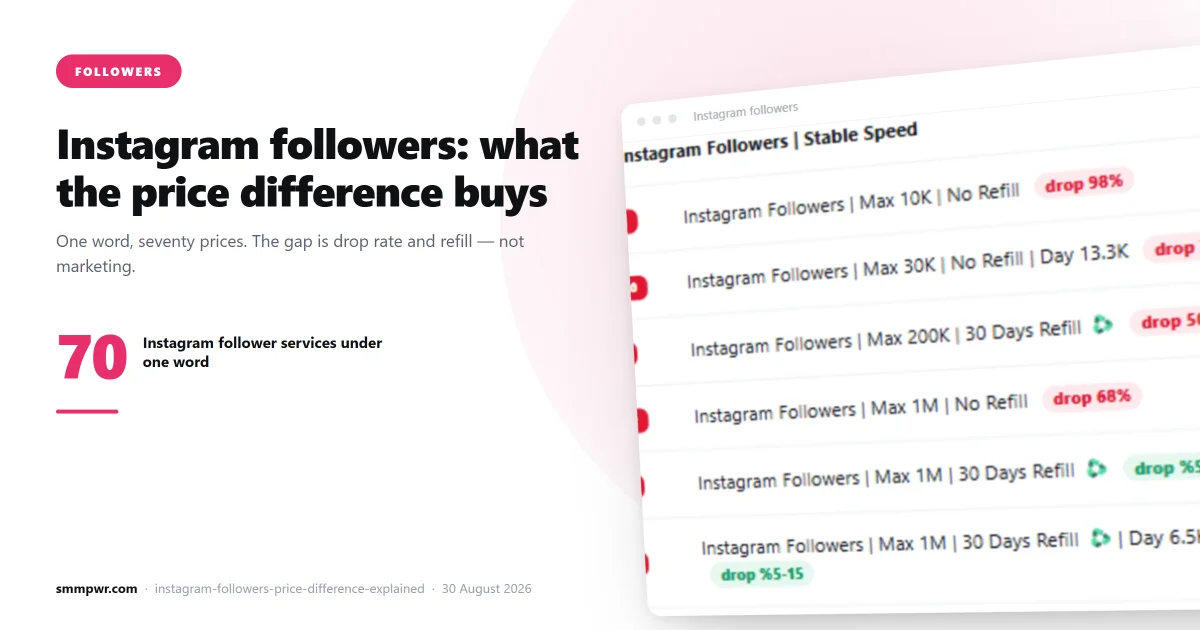
Open any SMM panel's follower category and you get a list of near-identical lines with different prices. The instinct is to assume price tracks quality: cheap means bots, expensive means real. That instinct is wrong often enough to cost you money.
A real example from our own catalogue
Here are the seven mixed-user Instagram follower services we currently list, exactly as priced:
| Price / 1000 | Maximum | Refill guarantee |
|---|---|---|
| $0.38 | 1,000,000 | 30 days |
| $0.55 | 1,000,000 | 30 days |
| $0.61 | 10,000,000 | None |
| $0.74 | 10,000,000 | 365 days |
| $0.76 | 1,000,000 | 30 days |
| $0.88 | 1,000,000 | 30 days |
| $1.38 | 1,000,000 | 30 days |
Look at the $0.61 line. It costs 61% more than the cheapest service and it carries no refill guarantee at all, while the $0.38 service is guaranteed for 30 days. If you sorted by price and assumed dearer meant safer, you would have picked a service with no protection over the cheapest one on the list.
This is not a trick or an error in our pricing. It reflects what the upstream provider charges and what they are willing to guarantee, and those two things do not move together. Price reflects supply cost. Guarantee reflects confidence. Read both.
The three lines that look identical
Now look at the $0.55, $0.76 and $0.88 services. Same maximum, same 30-day refill, same description: mixed users. Three different prices for what reads as the same product.
They are not the same. They come from different upstream sources with different account pools, different delivery speeds and different survival rates. But you cannot tell that from the name, and no amount of reading the description will tell you either. The description is written by the provider to sell the service.
This is the specific problem that made us publish delivery data. On each of those three services you can see the measured average completion time, the current queue time, and the historical drop rate. That is what actually separates them. The listing text does not.
How to read a follower service properly
1. Refill period, not the word "quality"
A refill guarantee is a mechanism you can act on: if the count drops inside the window, you request a refill from your orders page and the shortfall is topped back up. "High quality" and "real users" are adjectives with no enforcement behind them.
A 365-day refill is a meaningfully different product from a 30-day one, and on this list it is not even among the three dearest lines. No refill at any price is a gamble.
2. Cost per surviving follower
Drop rate turns headline price into real price, and our own measured figures make the point better than a hypothetical. The $0.38 service currently drops 52%, so you really paid $0.79 per 1000 followers that stayed. The $0.88 service drops 5-15% — $0.93 to $1.04 for the same thing. The $1.38 line sits in that same 5-15% band, the lowest published on this list. Compare those numbers, not the headline prices: the $0.55 line drops 5-15% too, so at $0.58-$0.65 per surviving 1000 it beats the $0.38 headline outright.
With a refill guarantee the calculation improves further, because drops inside the window get replaced, but only if you actually request the refill. Nobody does it for you.
3. The maximum tells you something
Notice the cheapest service caps at 1 million while two of the others go to 10 million. A low cap usually means a smaller, more controlled account pool. A 10-million cap means the provider is aggregating at scale. Neither is automatically better, but a cap is a signal about how the supply works.
4. Check the measured time before you order
A service with no published completion time, or one whose queue has stacked up, will happily take your order and sit at zero. This is the single most common way an SMM order goes wrong, and it takes five seconds to avoid.
How many to order
The mistake that gets accounts flagged is not buying followers. It is buying a quantity that does not fit the account.
An account with 800 followers and 40 likes per post that suddenly has 25,000 followers has an engagement rate of 0.16%, which is visible to anyone who looks and to any brand considering a partnership. The follower count went up; the account got less credible, not more.
If you are going to buy, buy in increments that keep your engagement ratio plausible, and spread them out. Minimums on these seven run from 10 to 50 depending on the service, so small test orders cost cents.
Drip-feed exists for exactly this: instead of 10,000 followers arriving in one block, you split the order into runs delivered at set intervals, so the growth curve looks like growth instead of a purchase.
What buying followers does not do
Worth stating plainly, because the industry avoids it:
- Purchased followers do not engage. Your engagement rate goes down, not up.
- They do not buy anything.
- They do not improve reach on their own. Instagram weighs engagement, and inactive followers dilute it.
The honest use case is social proof at the point of first impression: a visitor who lands on a profile with 12,000 followers treats it differently than one with 120. That effect is real, and it is the whole of it. Anyone selling followers as a growth strategy is selling you something else.
All seven services, with live prices and current delivery data, are on the services page. If you want the reasoning behind the numbers we publish, see drop rate and average time explained.
The same spread exists between panels, not just between services. We measured the lowest and median price per 1000 across eight public catalogues and published the figures in the cheapest-panel comparison.
Related services
What this article describes, on the price list:
- Instagram Followers — 173 services from $0.73 per 1000
- Instagram Likes — 171 services from $0.0051 per 1000
- Instagram SMM panel — the whole catalogue for that platform