
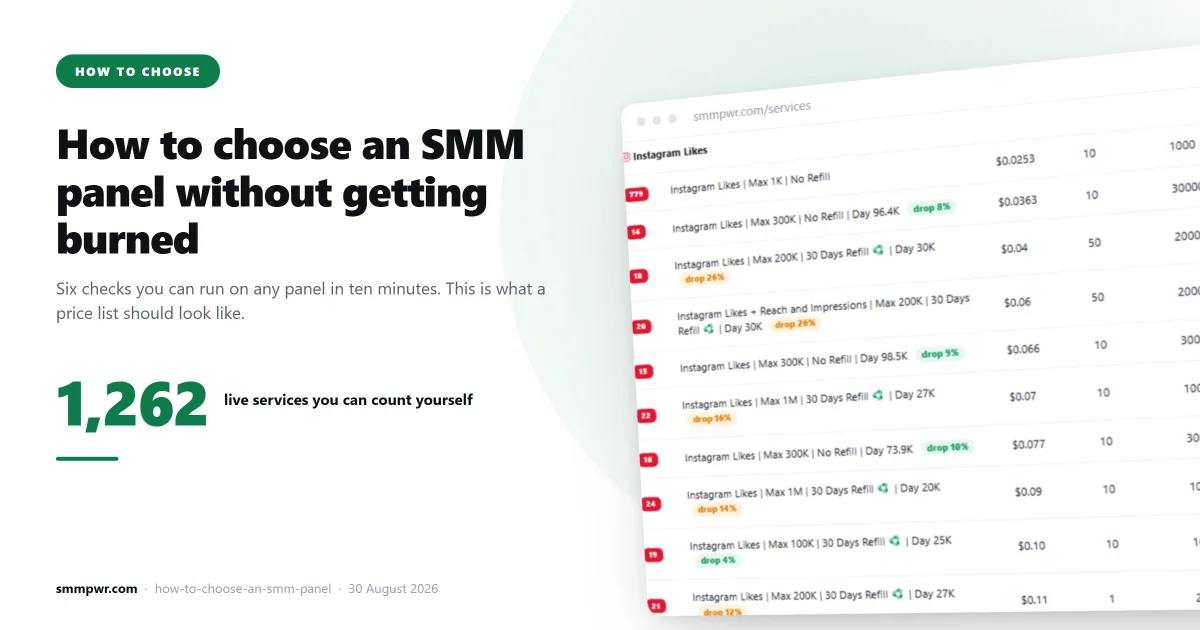
Search for an SMM panel and you get a wall of sites that look identical: the same dashboard template, the same claims, the same list of platforms. Comparison sites rank them by price, which is the one criterion that tells you almost nothing about whether an order will arrive.
Here is what actually distinguishes them.
1. Does the panel publish delivery data?
This is the fastest filter and it eliminates most of the market.
Every panel shows you a price. Very few show you whether a service is currently delivering. Those are completely different questions. A service can be listed, priced, orderable and dead. The provider behind it stopped working days ago, nobody removed the listing, and your order will sit at zero until you open a ticket.
Look for measured numbers: average completion time taken from real orders, current queue time, and historical drop rate. If the panel shows none of these, you are buying blind, and the panel is fine with that.
Be suspicious of numbers that look generated rather than measured. Tell-tale signs: an "average time" that is identical across dozens of unrelated services, values that are suspiciously round, figures that change when you reload the page, or a completion time that is really just a start time relabelled. A blank field is more honest than an invented one.
2. What happens when an order fails?
Orders fail. The question is what the panel does about it. Before depositing anything meaningful, find out:
- Are partial orders refunded automatically, or do you have to ask?
- Does cancellation work through the interface, or only by ticket?
- How long do tickets actually take to get answered?
The cheapest way to test this is to place a minimum order, usually 10 to 20 units costing a few cents, on a service you do not care about, and see what the process feels like. Do this before you put in $500.
3. Refill guarantees, and whether they are real
"Non-drop" is marketing. No panel controls whether a third party's accounts survive a platform purge, so nobody can promise they will.
A refill guarantee is different because it is a mechanism, not a claim: if the count drops within the guarantee window, you request a refill and the shortfall is topped back up. What matters is whether the button exists in the interface and whether pressing it does anything. Test it once on a small order.
When comparing a guaranteed service against a cheaper unguaranteed one, compare cost per surviving unit. A $0.45 service with a 30% drop rate delivers 700 lasting followers per 1000, or $0.64 per surviving 1000. An $0.80 service with a 5% drop rate delivers 950, or $0.84. Sometimes the cheap one still wins, but now you know by how much.
4. Payment methods and what they imply
Most panels have converged on cryptocurrency, and the reason is not ideological: card processors are reluctant to serve this industry, so card payments come and go. A panel advertising card payments may or may not have them working this week.
Crypto through an established processor is the norm. What to check is whether deposits credit automatically or need manual confirmation, and whether there is a minimum deposit that locks up more money than you want to commit while testing.
5. Catalogue depth versus catalogue honesty
A panel advertising "5000+ services" is not necessarily better than one with 1,466. Large catalogues are usually a single supplier's list imported wholesale, including everything broken, obsolete or duplicated. The count is a marketing number.
What matters more: does the catalogue tell you which services are actually working, and are the descriptions specific? "Instagram Followers - High Quality" tells you nothing. "Instagram Followers, max 200K, 30-day refill, mixed users" tells you what you are buying.
6. The API, even if you are not a reseller
A working API v2 implementation is a decent proxy for general technical competence. Panels that expose a proper API tend to be run by people who maintain their systems; panels without one are more often a template someone bought and never touched.
If you are reselling, check specifically that batch status queries work, that the service list is kept current, and that refill is exposed through the API and not interface-only.
7. What the panel refuses to sell you
An underrated signal. Panels that will sell absolutely anything, including services aimed at damaging competitors or engagement on categories of content that get accounts banned, are optimising for volume over durability. Those panels tend to disappear along with your balance.
A five-minute evaluation
- Open the services page. Can you see delivery data per service, or only prices?
- Pick one service. Does it show a measured completion time, or only a promise?
- Read three service descriptions. Are they specific or generic?
- Check the API documentation. Does it exist and cover batch operations?
- Deposit the minimum. Place a minimum order. Time how long it takes.
- Open a ticket asking something simple. Time the reply.
Six steps, and you know more than any comparison table will tell you.
How we score on our own checklist
Fair to state it plainly. Our catalogue is 1,466 services, not five thousand. 1,125 of them carry provider-reported delivery data — 1,079 publish an average completion time, 46 a live delivery speed and 39 a measured drop rate, refreshed every four minutes. The remaining services show what is known and leave the rest blank, because we would rather publish an empty field than an invented number.
Payments run through Cryptomus and Heleket with a 5% bonus on deposits from $200 and 7% from $1000, there is no subscription or minimum monthly spend, and the API is standard v2 with batch status and batch refill. Minimums sit at 20 units or fewer on 904 of the 1,466 services (10 units on 509 of them, a single unit on 152), which is deliberately low so you can test before committing.
Have a look at the services page and judge it against the checklist above, including against other panels. That is the point of writing the checklist down.
Related services
What this article describes, on the price list:
- Instagram Followers — 173 services from $0.73 per 1000
- Instagram SMM panel — the whole catalogue for that platform