
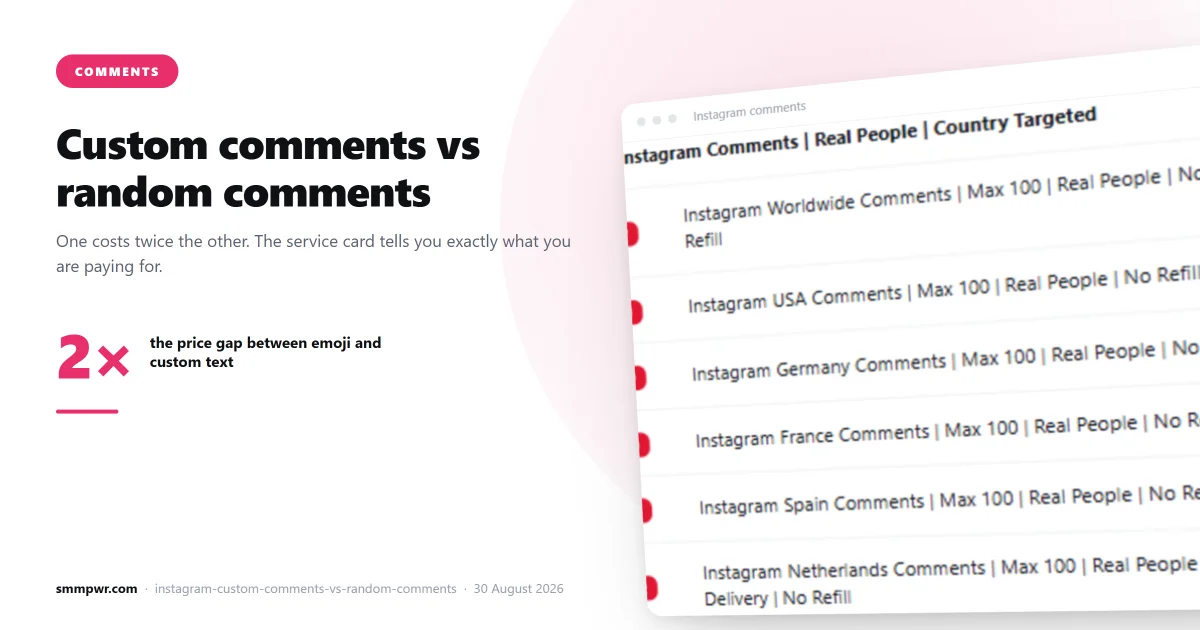
Comments are the most expensive engagement you can buy and the easiest to get badly wrong. A like is anonymous and generic. A comment is a piece of text sitting permanently under your post, visible to everyone, and if it does not fit it damages the thing it was meant to help.
Why the price gap is so large
Some perspective from our catalogue. Instagram likes start at $0.0253 per 1000. Comments start at $5.50 per 1000 and run up to $55.
That is a factor of roughly 220 at the low end. The reason is that a comment cannot be produced by a bot pool at scale without being obviously a bot pool at scale. Comments need either an account that will type something, or a text list you supply. Both are expensive compared with an automated tap.
The two categories
Random comments
The provider supplies the text from a generic pool. You pay per thousand and take what arrives. In our catalogue these include emoji-only comments at $5.50 per 1000, and language-specific pools (English, Russian, Ukrainian) from $24.20 to $55.
The generic pool is the problem. Random comments are the ones that read "nice pic 😍", "amazing!", "🔥🔥🔥" under a post about an office relocation. They are contextually blank, and on any post with actual subject matter the mismatch is visible.
Where they work: posts where a generic reaction is the appropriate reaction. A portrait, a product shot, a scenic photo. Emoji-only comments are the safest of the category precisely because an emoji carries no claim about content, so there is nothing to mismatch.
Custom comments
You supply the text. The service posts what you wrote, one comment per line. In our catalogue these run $11.02 per 1000 for the standard service and $16.50 (male) or $16.53 (female) for the gender-targeted variants.
Note what that means: custom comments are cheaper than most random-comment services here. The $11.02 custom service costs a fifth of the $55 English random pool. You are paying for delivery, not for someone to invent the words.
Custom is better in almost every case where you are willing to spend twenty minutes writing. You control relevance, tone, language and length, and you can write comments that ask questions or mention specifics that only someone who read the post would mention.
Writing custom comments that do not look bought
The failure mode is writing thirty comments that are all the same shape. Same length, same enthusiasm, same structure. That is a different tell from generic text but it is still a tell.
What helps:
- Vary the length badly. Real comment sections contain two-word replies and rambling three-sentence ones. If all your comments are 6–9 words, it shows.
- Let some be low-effort. Not every real comment is a thoughtful engagement. "lol" is realistic. Thirty thoughtful paragraphs are not.
- Include mistakes. Missing capitals, a typo, no punctuation. Real comments are typed on phones.
- Reference the post, but not all of them. If every single comment mentions the specific product, that is a coordinated campaign, not a comment section.
- Do not have them agree with each other. A question, a disagreement, an off-topic aside: that is what a real thread looks like.
Gender targeting
The male and female custom comment services exist because the account posting matters as much as the text. A women's fitness brand whose comment section is entirely male accounts has a mismatch that no amount of good writing fixes, and vice versa.
If your audience skews strongly one way, matching it is worth the extra $5.50 per 1000 over the untargeted service.
Order sizes are small on purpose
Look at the maximums: 40, 50, 100, 150, 200, 300, 1000, 1200 depending on the service. Compare with follower services that cap at 10 million.
That is not a limitation, it is the nature of the product. It is also a useful constraint, because the correct number of purchased comments is small. A post with 400 likes and 8 comments is normal. A post with 400 likes and 200 comments is not. The ratio is wrong by an order of magnitude, and comment-to-like ratio is one of the easiest things in the world to eyeball.
As a rule of thumb, comments should land somewhere between 1% and 4% of the like count on that post. Above that you are drawing attention rather than deflecting it.
When not to buy comments at all
- Posts with a call to action. If you are asking people to reply with their order number or their city, generic comments break the thread visibly.
- Anything controversial or newsworthy. Comment sections on those posts get read closely.
- Local business posts. Comments from accounts in the wrong country under a post about a neighbourhood shop are worse than an empty comment section.
- When the post is genuinely performing. Adding purchased comments to a post that is getting real ones dilutes the real signal.
An empty comment section is not a failure. It is the normal state of most posts on most accounts. The question worth asking before ordering is whether a comment section is the specific thing holding this post back, and usually it is not.
Before you order
Comments are expensive enough that a failed order hurts. Check the measured average completion time and the queue on the service first. A comment service with a long backlog should not be tested with your money. Minimums are 1 on every comment service in our catalogue, so a single-comment test costs almost nothing.
All eleven comment services, with live prices and delivery data, are on the services page. For how to read that data, see drop rate and average time explained.
Related services
What this article describes, on the price list:
- Instagram Comments — 46 services from $0.1043 per 1000
- Instagram Likes — 171 services from $0.0051 per 1000
- Instagram SMM panel — the whole catalogue for that platform
- SMM services targeted to Russia — the country-targeted part of the catalogue